← Ancient Oracles
The Alphabet Oracle
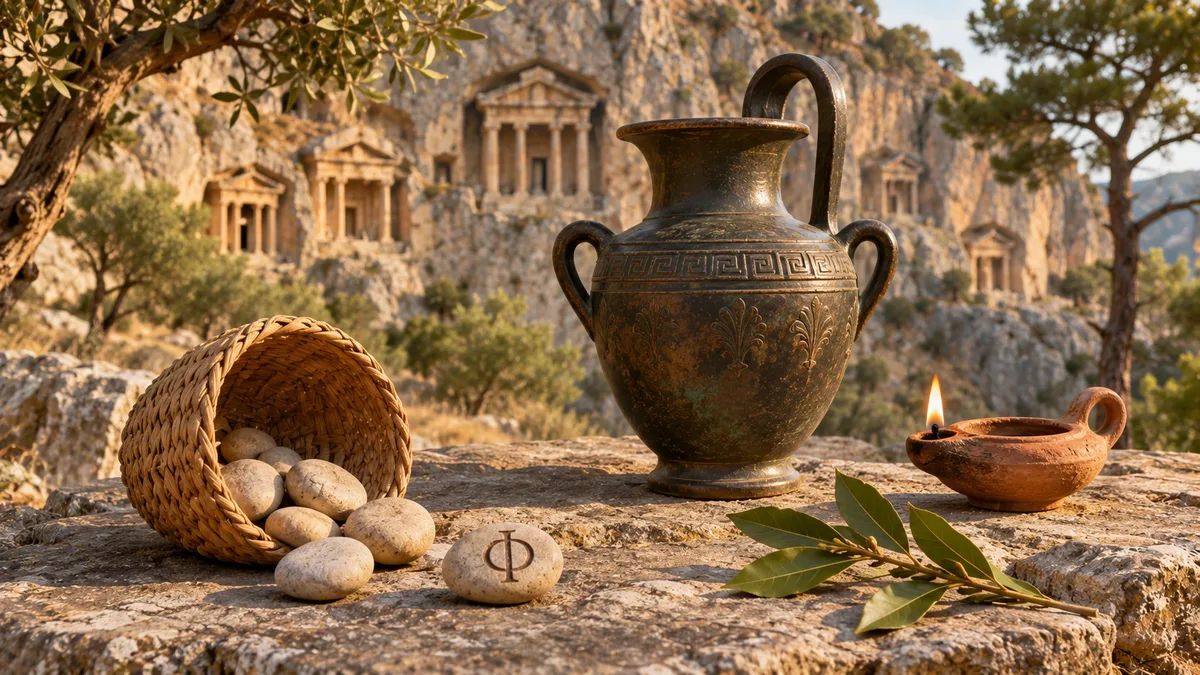
Below the tombs of Lycia: the jar, the pebbles, and one pebble drawn, marked Φ. In the towns of Roman Asia Minor, an oracle of 24 lines was carved on rock faces and tombs: one line for each letter of the Greek alphabet. You drew a pebble marked with a letter, and the line that began with that letter was the god's answer.
How to consult
Think of one clear question, and hold it in mind.
Tap Draw a pebble . The urn holds 24 pebbles, one for each letter of the Greek alphabet, and one comes out at random.
Read the line carved for your letter: it begins with that letter, and it is the god's answer. The reading underneath helps you see what it might mean for you. How do we know?
✔ Real stones. About a dozen copies of this kind of oracle survive in south-west Türkiye and on Cyprus, from the 2nd and early 3rd centuries AD: carved on rock faces, in rock sanctuaries and on the fronts of tombs.
✔ 24 lines. Every copy has one line for each letter from alpha to omega, and each line begins with its letter. Most are in the same verse rhythm.
✔ This text. The words here are a complete copy found near Limyra in Lycia, printed by Georg Kaibel in 1878. Letters in [ ] are worn on the stone and filled in by scholars.
✔ Apollo speaks. The lines name "the god", the Pythian (Apollo of Delphi) with Fortune, and Phoebus Apollo. Another copy, near Adada, begins with a prayer to Apollo and Hermes.
✔ A neighbour of Kibyra. Kibyra's own countryside had an alphabet oracle, as well as the knucklebone oracle in its market.
? Why pebbles? No source says exactly how a letter was chosen. Scholars since the 1800s suggest lettered pebbles drawn from an urn, and a small stone marked Φ found in Pisidia may be one of them. Twenty-sided dice lettered alpha to upsilon also survive, but they have no faces for the last four letters. A rarer 24-sided die of glass paste, with all 24 letters, is in the Canellopoulos collection in Athens; such dice were hard to make, so pebbles were probably more usual.
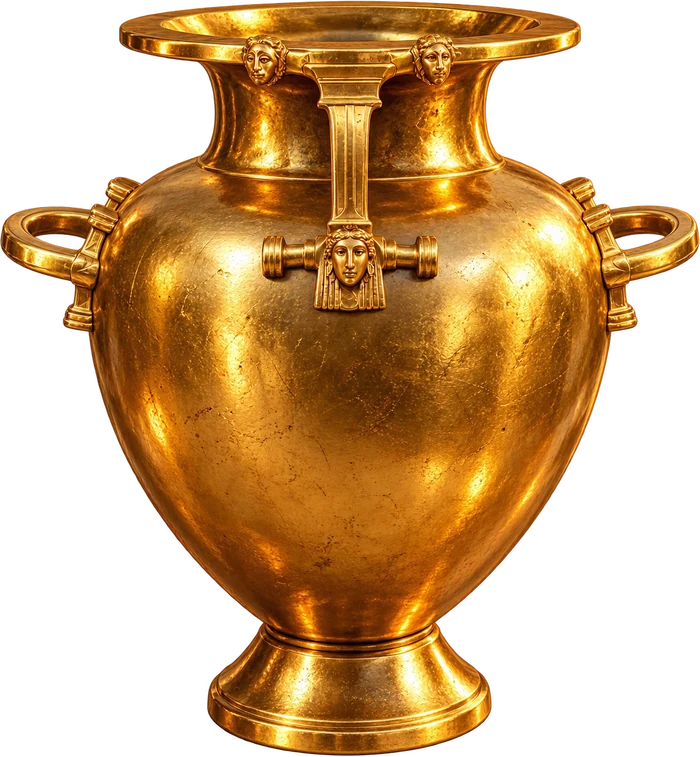
Greek text: Corpus Inscriptionum Graecarum 4310 = G. Kaibel, Epigrammata Graeca ex lapidibus conlecta (1878) no. 1039 (public domain). Kaibel keeps the stone's own spellings. English and readings: our own. Temple, jar, stone and cliff pictures: made for this app; the jar is a hydria, the water jar the Greeks often shook lots in. Sounds: Kenney (CC0).