The Bronze LotsSortes of Bahareno
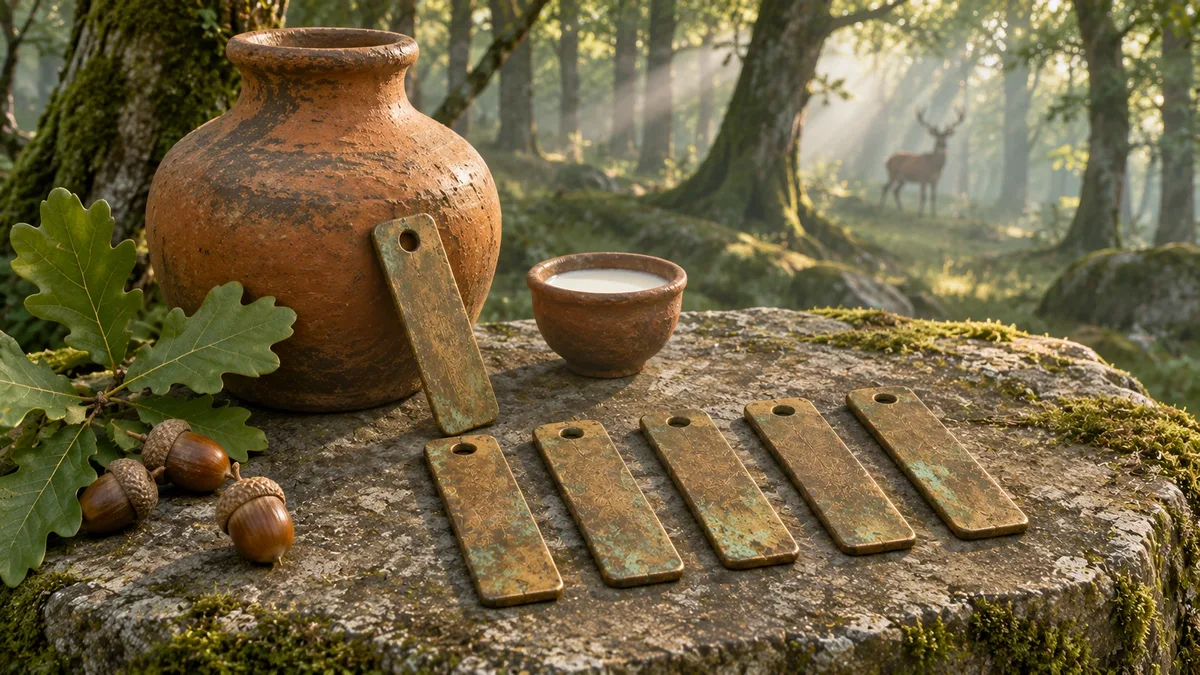
Over two thousand years ago, at a shrine somewhere in northern Italy, people asked the gods their questions by drawing a lot. Each lot was a little bronze plaque with one short answer in old Latin, sometimes kind, sometimes blunt, and sometimes cheeky: “Now you ask me? The time has already gone.” Seventeen of these lots were found in the 1500s, at a place the finder called Bahareno della Montagna.
How to consult
- Think of your question. Type it in if you like; it stays on your device.
- Tap Draw a lot. The jar holds the 17 bronze lots, and one comes out.
- Read the old Latin on the plaque, our English, and what it might mean for you. If the lot scolds you for asking badly, think again and ask again.
Your question and answers stay on this device.
Your past answers
How do we know?
- ✔ The lots were real. Seventeen bronze plaques were found in the 16th century. Three still survive, two in the Archaeological Museum in Florence and one in the Bibliothèque nationale in Paris; the other fourteen are known from copies made by Renaissance scholars.
- ✔ They are oracle answers. They speak of consulting and asking (consulis, rogitas, petis), and they read like the lot answers Roman writers quote. Their old-fashioned spelling (equos, tibei, nolei) points to the 2nd or 1st century BC.
- ≈ Where and whose. Nobody knows where Bahareno was: perhaps near Padua, perhaps near Bologna. One plaque has “to Diana, a gift” on its back, so the shrine may have been Diana's, but that is not certain.
- ≈ How they were drawn. Romans usually drew lots from a jar, sometimes by a child's hand, as at Fortuna's temple at Praeneste. Seventeen answers are probably not the whole set: other oracles had 24 or 56.
- ✔ Our words. The English translations and readings are written for this app. The Latin keeps the plaques' own old spellings.
Latin: CIL I² 2173–2189, as printed in F. Bücheler, Carmina Latina Epigraphica (1895) no. 331 (public domain), with Mommsen's and Degrassi's readings where Bücheler fills gaps. About the lots: L. Buchholz, “Identifying the oracular sortes of Italy”, in Studies in Ancient Oracles and Divination (2013). English and readings: our own. The jar is the app's picture of a water jar. Grove picture: made for this app. Sounds: Kenney (CC0).
The god is listening.