The Bower Manuscript Dicea Pāśaka-kevalī from Kucha on the Silk Road
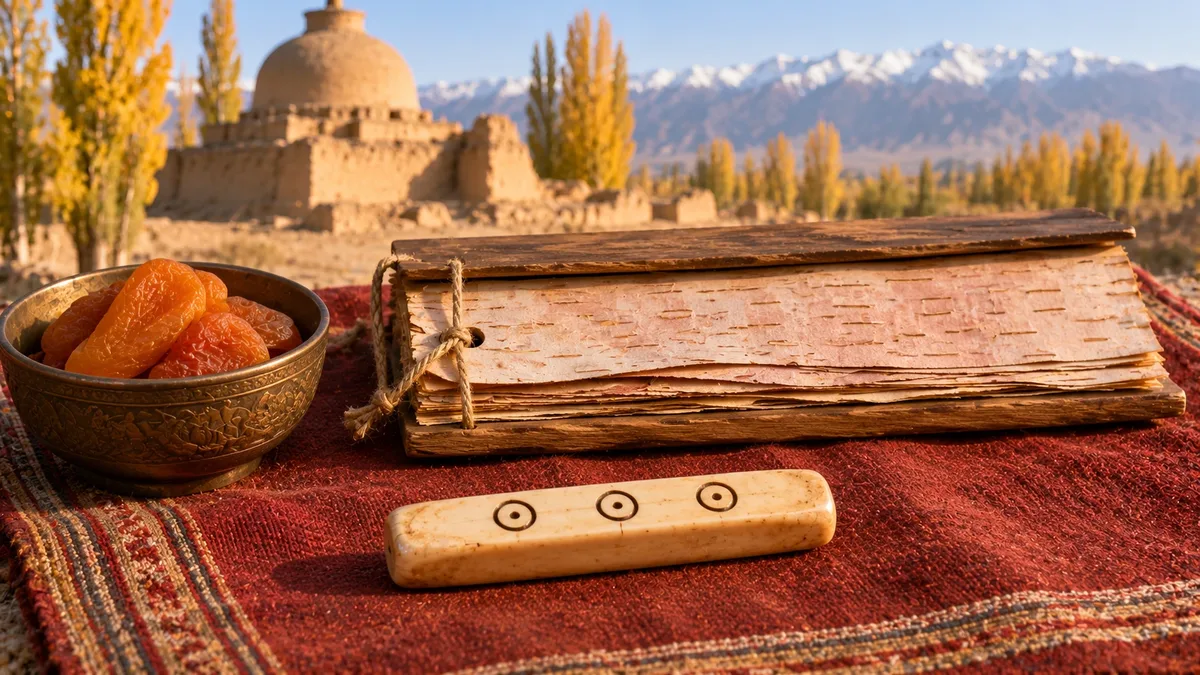
In 1890 a British officer, Hamilton Bower, bought an old book that local men had dug out of a ruined stupa near Kucha, an oasis town on the Silk Road. It was written on strips of birch bark in an Indian script, about 1,500 years ago. Two of its parts are dice oracles. This is the first: throw a long four-sided die three times, and the book gives you one verse, often with a god's blessing.
How to consult
- Think of your question. Type it in if you like; it stays on your device.
- Tap Throw the die. The die (a pāśaka, with 1 to 4 rings on its long faces) is thrown three times. The order counts: 4-4-3 and 3-4-4 are different answers.
- Read the old verse in our English, and what it might mean for you. Four of the 64 answers are lost; if you throw one, the book is silent.
The charm before the dice
The book opens with this prayer and charm (our English, shortened, after Hoernle).
Your question and answers stay on this device.
Your past answers
How do we know?
- ✔ The book is real. The Bower Manuscript is now in the Bodleian Library, Oxford. It has seven parts: three medical books, two dice oracles and two books of charms. Its script dates it to about the 6th century AD.
- ✔ This is a dice oracle. Its opening charm tells the dice to fall, and every answer is headed by a throw of three numbers from 1 to 4. A. F. R. Hoernle printed and translated it between 1893 and 1912. Books like it, called Pāśaka-kevalī, were still copied in India centuries later.
- ✔ 59 of the 64 answers survive in this part. Throw 4-1-2 is numbered but its verse is blank, so we use the 4-1-2 verse from Part V, the second dice book in the same manuscript. Throws 1-2-1, 1-2-4, 2-1-1 and 2-3-4 are lost.
- ≈ One die or three? The charm says “let the dice fall”, but because the order counts, the three numbers were probably thrown one after another, as here. The die is the long Indian kind, shaped like a little rod.
- ≈ The class names. The answers are grouped under names such as Dundubhi (drum), Vṛisha (bull) and Śakti (power). These are ordinary Sanskrit words; nobody knows why each was chosen.
- ✔ Our words. The English versions are our own, made from Hoernle's translation; we have softened three verses for younger readers. The readings are written for this app. The Sanskrit is Hoernle's, with the accent marks simplified.
Source: A. F. R. Hoernle, The Bower Manuscript (Calcutta, 1893–1912), Parts IV and V (public domain). English versions and readings: our own. Kucha picture: made for this app. Sounds: Kenney (CC0).
First throw
Second throw
Third throw
The die waits on the cloth.