← Ancient Oracles
The Coin of Janus
New Year's morning at the gateway of Janus: heads, ships, and the sweet gifts. It is the Kalends of January, the first day of the year, at the bronze gateway of Janus in the Forum. Bring the god a sweet gift, say the old prayer, and toss his coin: once for a plain yes or no, or three times for a longer answer. His face opens a door; Saturn's ship sails on.
1. Bring a sweet gift
Romans gave sweet things at New Year, "so that the year may be sweet".
2. Call on Janus first
I have said the prayer
The god of doors waits for your toss.
How to read the coin
Janus (heads, capita ): the god of doors. A way opens.The ship (navia ): Saturn's voyage. Something out of your hands, a journey, or "not yet".One toss: Janus means yes, the ship means no or not yet.Three tosses make eight answers: where the faces and ships fall says when the door opens.How do we know?
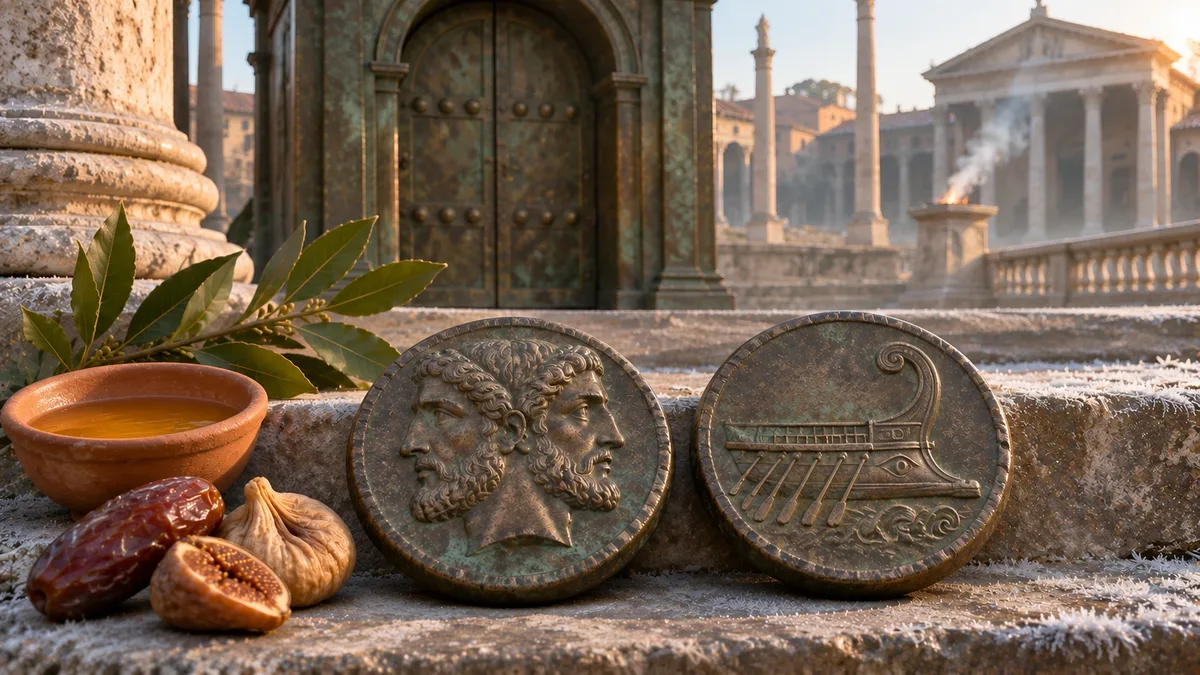
✔ The coin. The aes grave , "heavy bronze": Rome's as , cast about 225-217 BC and weighing around 270 grams. One side shows two-faced Janus with the mark I (one as ); the other, a ship's prow with ROMA.
✔ Why a ship? Macrobius and Ovid tell how Saturn sailed to Italy and King Janus welcomed him, and how Janus first cast bronze coins with his own head and, for Saturn, a ship. Roman children tossed coins calling capita aut navia , "heads or ships".
✔ Janus comes first. Romans named Janus first in their prayers. In Ovid's poem he explains why: he keeps the doors, and through him you reach the other gods. The prayer here is real, from Cato's book on farming.
✔ New Year gifts. On the Kalends of January, Romans gave honey, dates, figs and coins, so the year would be sweet.
✔ His gateway. The shrine of Janus in the Forum was a bronze gateway with doors at both ends, open in war and shut in peace.
? The oracle is ours. No source says Romans consulted Janus with his coin. The single toss is closest to the real game of "heads or ships", read here as yes or no. The three tosses and their eight answers are a modern invention built on his story.
Sources: Ovid, Fasti book 1; Macrobius, Saturnalia 1.7; Cato, On Farming 134. Translations and answers: our own. Forum picture: made for this app. Coin sound: Kenney (CC0).