The Gospel LotsSortes in the margins of Saint John
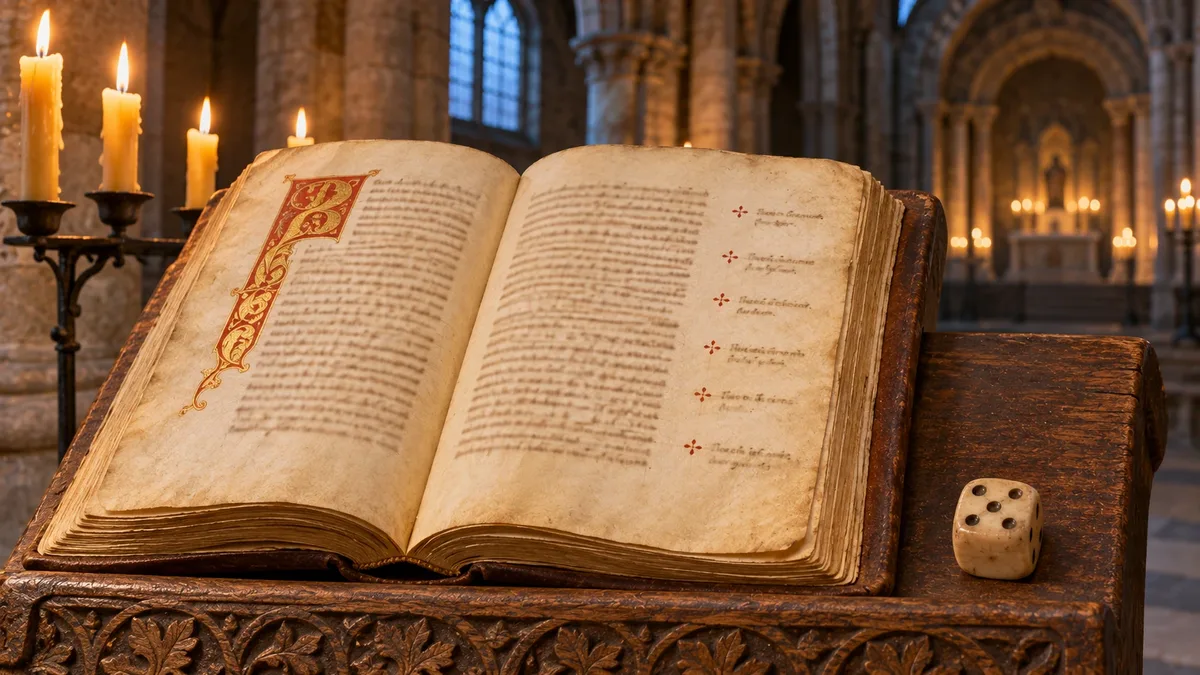
In a Latin Gospel book from the Abbey of Saint-Germain-des-Prés in Paris, a medieval scribe filled the margins of the Gospel of John with short numbered answers: spes bona, “good hope”; noli timere, “do not be afraid”; quod verum est dicito, “say what is true”. They are oracle answers. The numbers reach 216, which is exactly how many ways one die can fall in three throws. Throw it three times, find the number in the margin, and read what the scribe wrote there.
From the margins
- xiiiSpes bona.Good hope.
- xlviiSecreta incipit revelare.Secrets begin to come to light.
- cxcviiiNe accipias istos sermones, quia duas facies habent.Do not accept these words, for they have two faces.
- cciEx maerore ad gloriam veniet.From grief it will come to glory.
How to consult
- Think of one clear question. Type it in if you like; it stays on your device.
- Tap Throw the die. It is thrown three times. The first throw counts in thirty-sixes, the second in sixes, and the third in ones, so the three throws make one number from 1 to 216.
- Read what is written in the margin at that number. Some numbers have two or three answers; some have none, because the margin is empty or the leaf is lost. Then the lot is silent: throw again.
Your question and answers stay on this device.
Your past answers
How do we know?
- ✔ The book is real. The Codex Sangermanensis is a Latin Bible of the 9th century from the Abbey of Saint-Germain-des-Prés, now in the national library in Paris. In the margins of the Gospel of John, a medieval hand wrote numbered answers, running up to 316.
- ✔ A Greek twin. The famous Codex Bezae in Cambridge has about seventy of the same answers in Greek, added around the 10th century at the foot of the pages of Mark. In 1901 Rendel Harris printed the two series side by side and showed they come from one source, written in the margins of a Latin Gospel of John.
- ✔ Not quotations. The answers do not quote the Bible. They are short, ordinary oracle sayings that borrow their holiness from the Gospel around them, a practice church councils called “the lots of the saints”.
- ≈ Why dice? No instructions survive. Harris noticed that one die thrown three times, counting the order, gives 6 × 6 × 6 = 216 throws, and suspected that the series began as 216 answers and later grew to 316. Our way of turning three throws into a number is the simplest: the Homer oracle's papyrus uses the same counting. Others may have opened the book at random and read the nearest answer.
- ≈ Gaps and repeats. The scribe's numbering is irregular: some numbers are missing, some are used twice, and a few notes are headings, Bible readings or lectionary notes copied by mistake. We keep the manuscript's own numbers from 1 to 216, show every answer written at a number, and leave out the headings and damaged lines. That leaves 116 answers at 100 numbers.
- ✔ Our words. The English translations and readings are written for this app. The Latin follows Harris's transcription, with abbreviations written out.
Latin: J. Rendel Harris, The Annotators of the Codex Bezae (with some notes on Sortes Sanctorum), London 1901, pp. 59–67 (public domain), from a transcript of Paris, BnF lat. 11553. English and readings: our own. Church picture: made for this app. Sounds: Kenney (CC0).
Hold your question in mind, and throw.
The Gospel lies open.