← Ancient Oracles
The Palm-Leaf Oracle
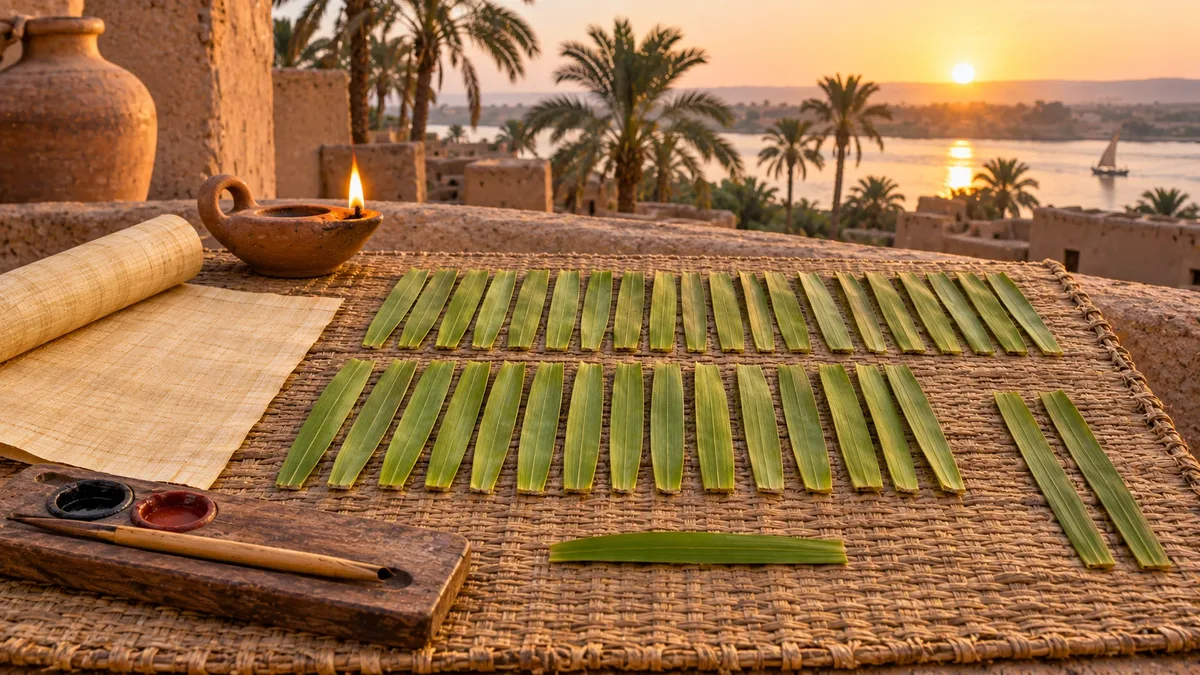
Sunrise over the Nile: the leaves face down, a pair lifted away, and one left alone. "A copy of a holy book found in the treasuries of Hermes." Write the names of 29 gods on palm leaves, lift them away two by two, and read the one that is left: that god holds your answer. From a papyrus of Roman Egypt, about 1,750 years old.
🌿 Lay out the leaves
First, call on the Sun and all the gods of the deep about the thing you want an omen for. Then lay out the leaves.
Lift them for me
The leaves wait, face down, on the mat.
How to consult
Think of what you want an omen about, and call on the Sun and the gods of the deep.
Lay out the 29 leaves. Each has a god's name on its hidden side.
Lift the leaves away two at a time: tap two leaves, then two more, fourteen times.
One leaf will be left. Read it: that god gives your answer. How do we know?
✔ A real papyrus. A sheet from Oxyrhynchus in Egypt, 3rd century AD, published in 1908 (P.Oxy. 886). It is short, and its scribe could barely spell.
✔ The method. 29 palm leaves, each with "the names of the gods"; a prayer to the Sun and the gods of the deep; lift them two by two; read the last.
✔ The story. The papyrus says Hermes and Isis used it when Isis was searching for her husband Osiris, whom Seth had killed and scattered.
? Which 29 gods? The papyrus never lists them, nor says what each means. Our list and answers are a modern reconstruction: gods worshipped in Roman Egypt, with the papyrus's own Hermes, Isis, Osiris, the Sun and "the Deep".
? Why 29? The papyrus speaks of "the 29 letters", which no one has explained. An odd number is needed so that one leaf is left after lifting pairs. 29 is also about the length of a moon's month.
Our 29 gods Papyrus: B. P. Grenfell and A. S. Hunt, The Oxyrhynchus Papyri VI (1908) no. 886. English and the 29 answers: our own. Rooftop picture: made for this app. Sounds: none.