The Counting Rods 算卜
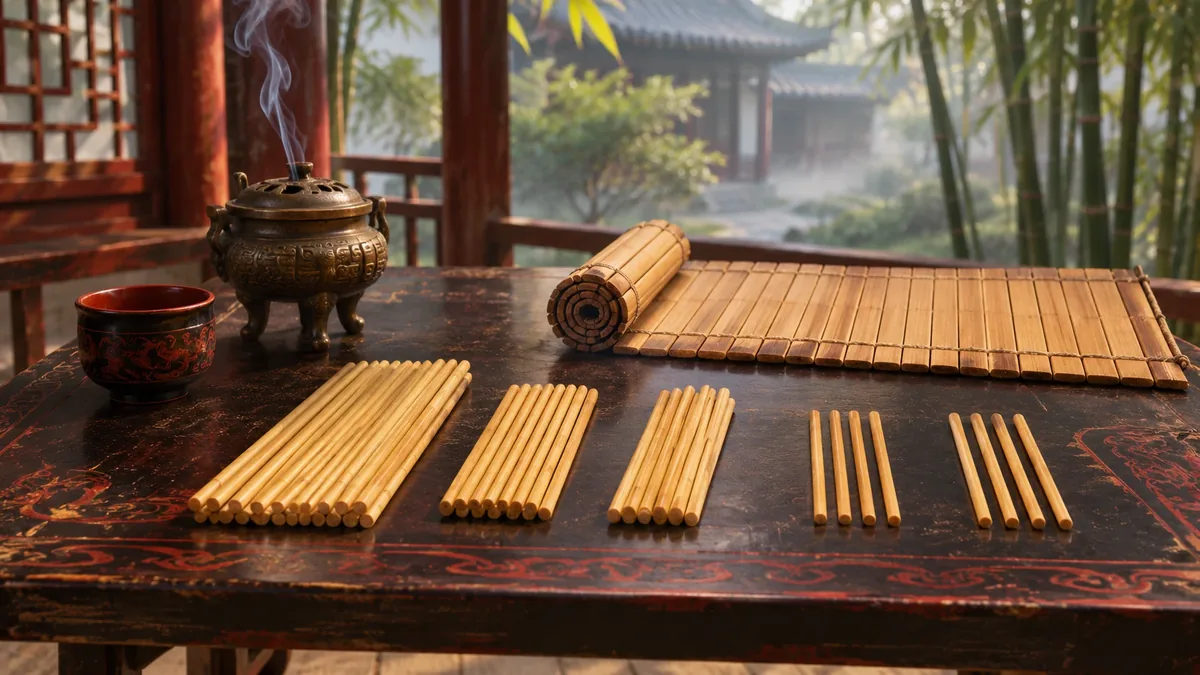
Two thousand years ago, Chinese diviners carried bundles of little bamboo rods, the same rods they used for counting. To ask a question, you split the bundle into three piles without counting, took each pile away four rods at a time, and looked at what was left: three numbers from 1 to 4, making one of sixteen figures. Three books from ancient China read these figures, each in its own way. Here one cast of the rods is read in all three.
How to consult
- The Tricks of Jing says to face east, holding the book in your left hand and the rods in your right.
- Think of your question. Type it in if you like; it stays on your device.
- Choose the bundle: 30 rods, as in the Tricks of Jing, or 34, as in the books of the Duke of Zhou and Guan Gongming. Both give the same sixteen figures.
- Tap Cast the rods. The bundle is split into three piles; each pile is taken away in fours until four or fewer are left.
- Read what the three books say about your figure, and our reading of all three together.
Your question and answers stay on this device.
Your past answers
How do we know?
- ✔ The Tricks of Jing (荊決) is written on 33 bamboo slips of the Western Han dynasty, about the 2nd century BC, now at Peking University. At least two slips are missing.
- ✔ The Duke of Zhou and Guan Gongming methods are paper manuscripts from the library cave at Dunhuang, about a thousand years later, now in Paris and Beijing. Their first pages are partly lost.
- ✔ The same cast. All three split the rods into three piles and take them away by fours. Because 30 and 34 both leave 2 over when divided by 4, the three numbers always add up to 6 or 10, so there are exactly sixteen figures.
- ≈ Gaps. Where a slip or page is lost, the app says so. A few characters are uncertain; the notes say where.
- ≈ Reading the three together is our idea: no ancient diviner had all three books at once. Each book's own answer is given first.
- ✔ Our words. The English translations and the modern readings are written for this app.
Chinese text: B. Dotson, C. A. Cook and Zhao Lu, Dice and Gods on the Silk Road (Brill, 2021), appendix “Divining with Sixteen Numerical Trigrams”, (open access, CC BY-NC 4.0), reading the Peking University Han slips and Dunhuang manuscripts P.3398, San 678, P.4778 and P.3868. English and readings: our own.
Face east. Hold the book in your left hand and the rods in your right.
The three books lie open.