The Lots of the SaintsSortes Sanctorum
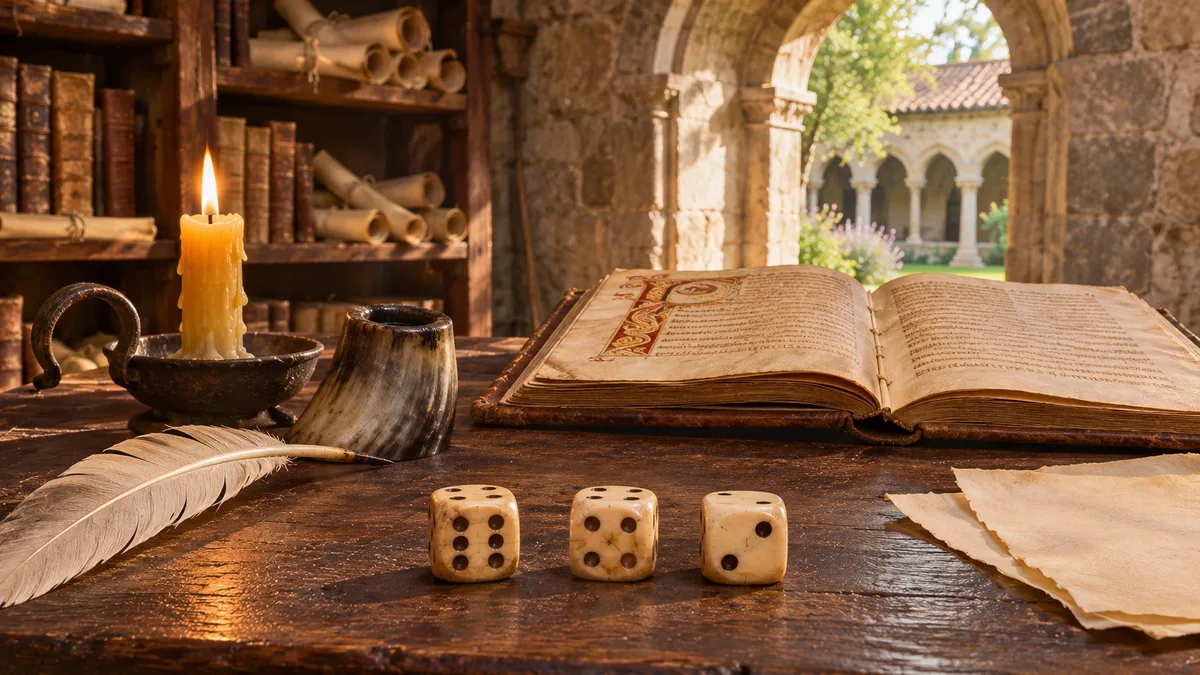
Long ago, in the last centuries of the Roman Empire and on into the Middle Ages, Christians in Gaul and beyond asked their questions with three dice and a little book. Throw the three dice together, read them from the highest number down, and look up the answer: 56 short sayings in Latin, full of ships and harbours, deer in the forest, honey and vinegar, and the help of God. Bishops banned it again and again, but monks kept copying it.
Haec sunt sortes sanctorum quae numquam falluntur…
These are the lots of the saints, which never deceive…
How to consult
- The manuscripts say the lots tell the truth to those who come with fasting and prayer. Be quiet for a moment, and pray in your own way if you wish.
- Think of your question. Type it in if you like; it stays on your device.
- Tap Throw the three dice. The numbers are read from the highest down, so 2, 6 and 4 is read as 6-4-2.
- Read your answer. A few answers say the lots will not speak today: then come back another day, as the book says.
Your question and answers stay on this device.
Your past answers
How do we know?
- ✔ The book is real. Several manuscripts of the Sortes Sanctorum survive, the oldest from the 8th and 9th centuries, copied in France, Germany and Austria. Some are in books for training priests, beside dream books and Bible notes.
- ✔ Three dice, 56 answers. Each answer is headed by its throw, from 6-6-6 down to 1-1-1. The book is older than the copies: scholars think it began in Late Antiquity, perhaps in Roman Gaul.
- ✔ How it was used, and banned. Church councils in Gaul in the 5th and 6th centuries forbade clergy and lay people to use "the lots of the saints", which shows how popular they were.
- ≈ The text. No two copies agree word for word: scribes changed, added and misread. Our Latin follows one copy, mended from another where it is broken, with spelling made easier to read.
- ✔ Our words. The English translation and the modern readings are written for this app.
Latin: the medieval manuscripts (public domain): Vienna, Österreichische Nationalbibliothek, Cod. 2723 (10th century, Mondsee), mended from Berlin, Staatsbibliothek, MS Phill. 1775 (12th century, Tours), from the transcriptions in M. Schalekamp, “These Lots Never Deceive”; the Latin as given here is our own edition. English and readings: our own. Scriptorium picture: made for this app.
Be still a moment. Hold your question in mind, and throw.
The book lies open.