The Turkic Book of OmensA falnama from Khwarezm, about 1362
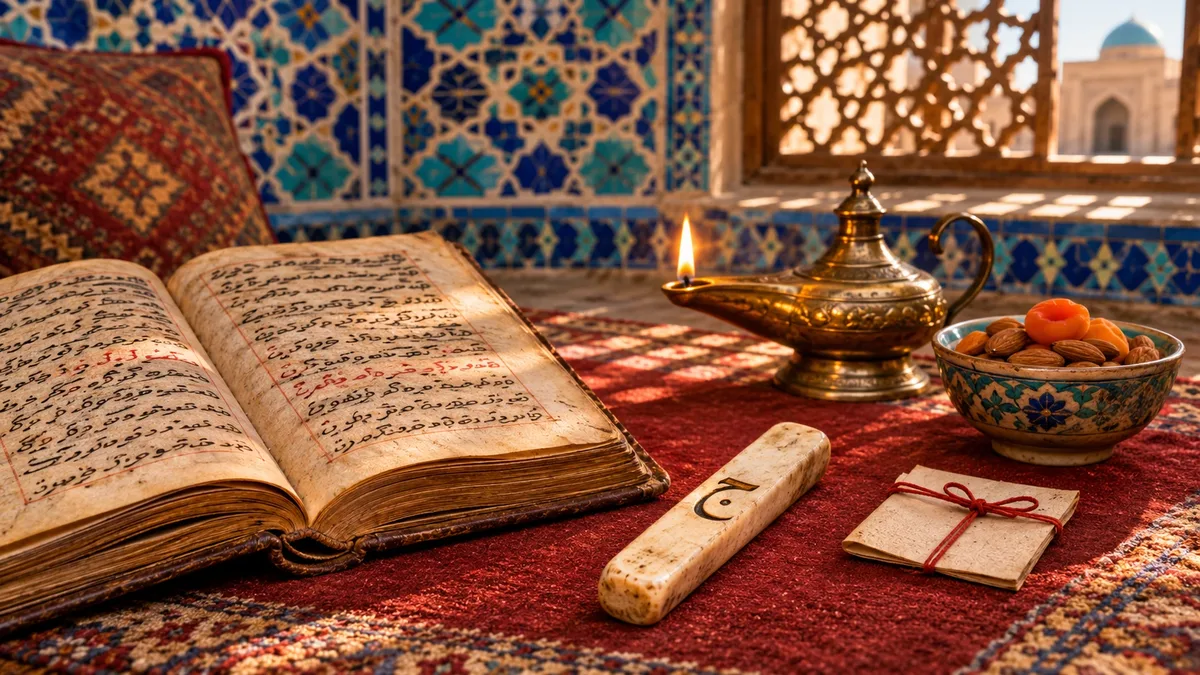
In the Topkapı Palace in Istanbul there is a small handwritten book in an old Turkic language, copied around the year 1362 in or near Khwarezm, the rich oasis land south of the Aral Sea. It is the oldest known Turkic falnama, a book of omens, two centuries older than the great painted falnamas of Persia and the Ottomans.
You wash, clear your heart of any wrong you have done, say a short prayer, and take the lot in your right hand. Then you throw it three times. It has four faces, marked with the first four letters of the Arabic alphabet, ا ب ج د. Every set of three letters has its own answer, which speaks to you directly: "O seeker of the omen! The omen that has come to you is a beautiful one…"
How to consult
- Think of your question. Type it in if you like; it stays on your device.
- Tap Throw the lot. The four-sided die is thrown three times.
- Read the answer for your three letters. The book says a good answer needs only one throw; if it is bad, you may throw again two or three times.
- Some pages of the book are lost. If your letters fall on a lost page, throw again.
The four faces
The first four letters of the Arabic alphabet, also used for the numbers one to four.
Your question and answers stay on this device.
Your past omens
How do we know?
- ✔ The manuscript. Topkapı Palace Museum Library, MS K1057. It holds two works in Khwarezmian Turkic in the same hand. The first is dated 1362, so the book of omens was copied at about the same time. It is the earliest known book of omens in Turkic.
- ✔ The text. Samet Onur published the full Turkic text as a free digital edition in 2024, at Uppsala University's Database of Middle Turkic Documents, under a Creative Commons licence. Our English is translated from his edition.
- ✔ The method. The book says to wash, pray, put away any wrong in your heart, say a short prayer asking to be shown whether the matter is right or wrong, take the lot in your right hand, and throw it three times. "If it comes out good, one throw is enough. If it comes out bad, throw two or three times."
- ✔ Lost pages. The last pages of the manuscript are missing. Of the 64 possible sets of three letters, 40 survive. Every set beginning with د (dāl) is lost, and a few others, and two answers are damaged.
- ✔ What we left out. In the manuscript each answer opens with a short religious quotation before the answer itself. We give only the answers.
- ≈ The die. The text says only "throw the lot", and heads each answer with three of the four letters. Later books of lots in Persian and Ottoman Turkish use a four-sided die with these letters on its faces, so the app shows one.
- ✔ The charm. Almost every answer ends with the same advice: "Do not go about without a written charm." Small written amulets, worn or carried, were part of everyday life. The answers also warn often against the evil tongue and the evil eye.
- ✔ A long tradition. Books of omens like this were made across the Islamic world for centuries, from little working copies like this one to the huge painted falnamas made for Shah Tahmasp of Persia and Sultan Ahmed I of the Ottomans in the 1500s and 1600s.
- ✔ Our words. The English translation and the one-line summaries are written for this app. We have kept close to the meaning, and simplified a few repeated phrases.
Turkic text: Samet Onur (2024), "A digital edition of the Khwarezmian Turkic fortune-telling book K1057", in László Károly and Michał Németh (eds), A database of Middle Turkic documents, Uppsala University, middleturkic.lingfil.uu.se, licensed CC BY 4.0. Manuscript: Topkapı Palace Museum Library, K1057. Background: M. Farhad and S. Bağcı (eds), Falnama: The Book of Omens (2009) (facts only). English: our own. Caravanserai picture: made for this app. Sounds: Kenney (CC0).
The book is waiting.